Computational Fluid Dynamics Set up
After the model is created, it can be passed to CFD simulation and the initial parameters of the simulation are specified as follows.

The overall objective of this very paper is to optimize the design of airfoil, specifically by exploring the effect of changing aspect ratio and angle of attack on aircraft performance, in a simplified case with certain initial conditions and boundary conditions.
Creation of 3D model in Solidworks
Creation of geometry is conducted by using 2D coordinates data from database of "airfoil database research" and then extruded for certain lengths, which are also affect the aspect ratio.
The airfoil is rotated for different degrees and this also determines the angle of attack.
Aspect ratio: ratio between the wingspan and the chord length. The values of 1, 1.25, 1.50, 1.75 and 2.00 are selected for exploration in the paper.
Angle of attack: the angle at which the chord of an aircraft's wing meets the relative wind. The values of 0°, 5°, 10°, 15° and 20° are selected for exploration in the paper.
Computational Fluid Dynamics Set up
After the model is created, it can be passed to CFD simulation and the initial parameters of the simulation are specified as follows.
Mathematical Model
The formula for calculating drag and lift coefficients are listed as the following.
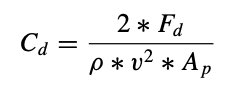
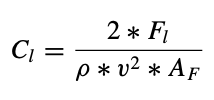
Where:
Fd and Fl are drag force and lift force, respectively. They are calculated from the results of simulation. ρ is the density of the fluid, which is air in this case of
1.2004 kg ∗ m3; v is the velocity of the fluid, which is set as 34.3 ms−1 for the initial
condition.
Ap and Af are the frontal and the planform area of the airfoil. The specific derivations and calculations of area can be found in the actual paper.
By using flow simulation from solidworks and also the numerical calculation from python programming, the following results regarding the performance of NACA 24112 could be obtained.
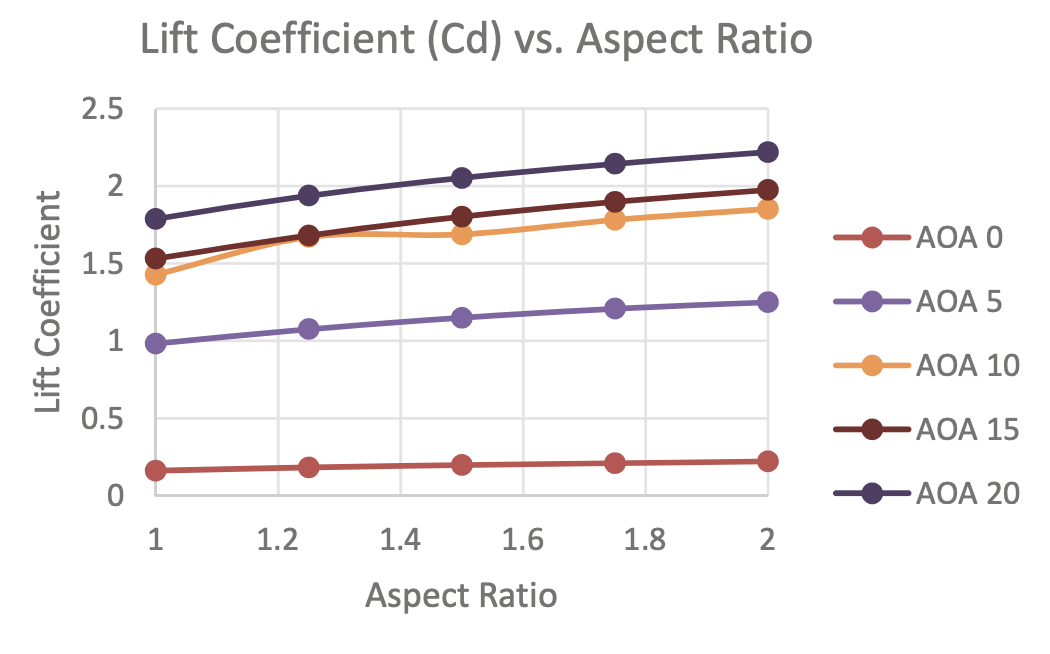
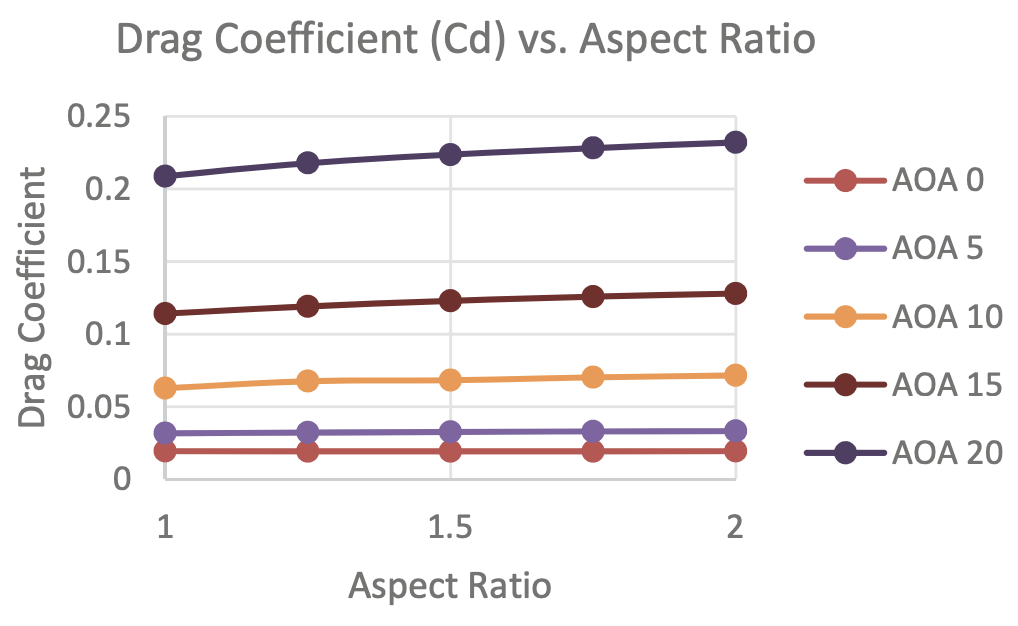
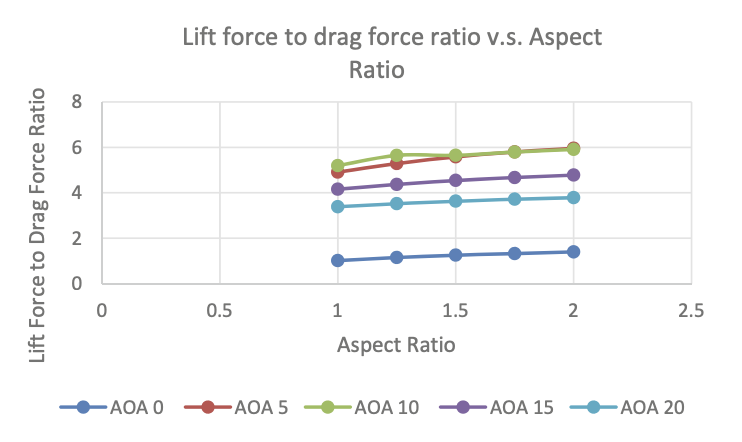
For the purpose of optimization of airfoil performance, the aspect ratio and angle of attack shall be selected as 2 and 5°, respectively, with a LDR value of 5.955. In this case, the drag coefficient and lift coefficient are approximately 0.0333 and 1.249.
This site was created with the Nicepage